
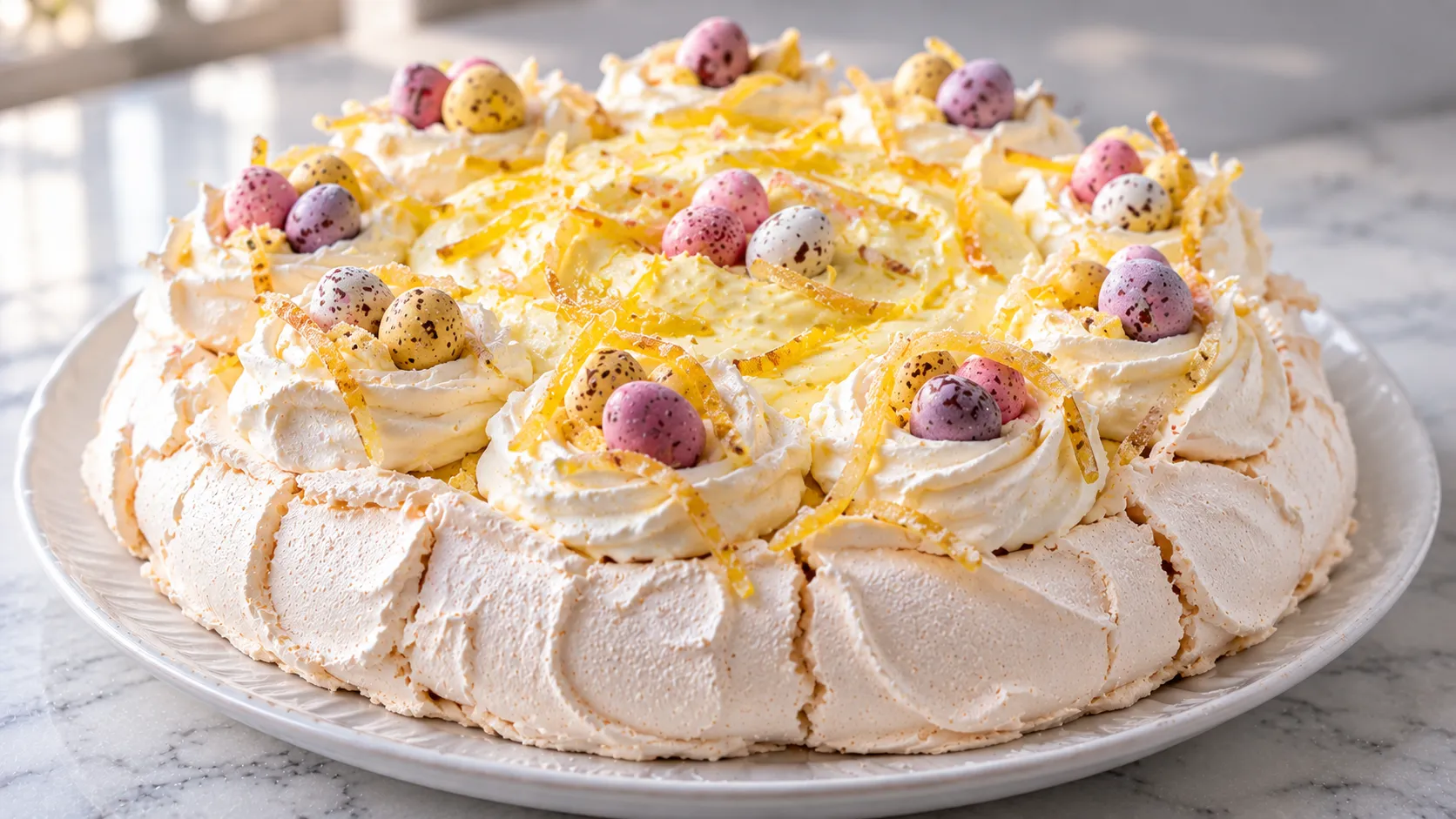
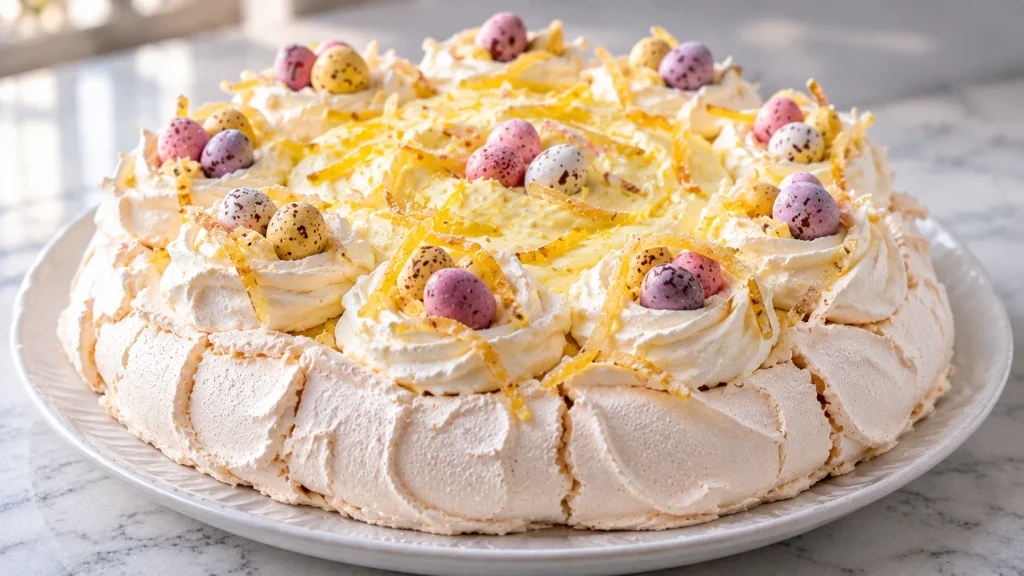
There is something especially inviting about a pavlova with a crisp meringue shell, soft centre, bright lemon flavour, and a festive Easter finish. This Mary Berry Easter Lemon Pavlova Recipe combines delicate meringue with creamy lemon curd, soft whipped cream, chocolate mini-eggs, and candied lemon zest for a dessert with contrasting textures and fresh citrus character.
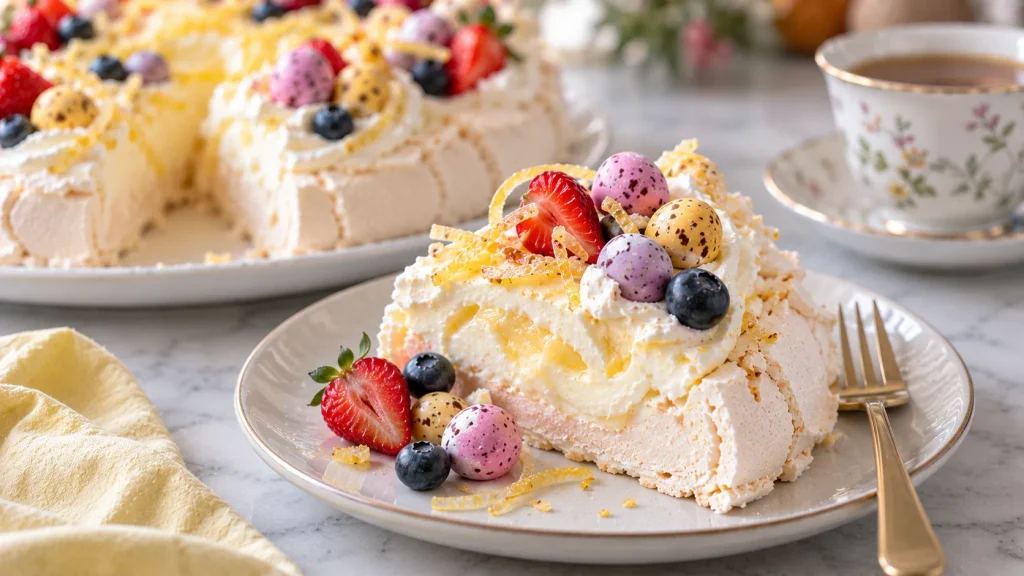
The small meringue nests around the edge give the pavlova its distinctive presentation, while the lemon cream and chocolate eggs make it suited to Easter gatherings. Read on to discover the ingredients and equipment, step-by-step method, serving ideas, storage guidance, answers to common questions, and the available nutrition information.
Equipment
Equipments for Mary Berry Easter Lemon Pavlova Recipe:
You only need a few basic kitchen tools to prepare this pavlova. The equipment helps you create a smooth meringue, prepare the lemon filling, shape the small nests, and finish the dessert neatly before serving.
- Baking paper – prevents the meringue from sticking to the tray.
- Baking tray – provides a flat surface for baking the pavlova.
- Electric hand-whisk – quickly whisks the egg whites into a stiff meringue.
- Free-standing mixer – can be used instead of a hand-whisk for mixing the meringue.
- Bowl – holds the egg whites and other mixtures during preparation.
- Cup – helps measure ingredients accurately.
- Piping bag – shapes the meringue into small nests.
- Saucepan – gently cooks the lemon curd mixture.
- Peeler – creates thin strips of lemon zest for decoration.
- Knife – cuts and prepares the lemon zest.
- Wire rack – allows the baked meringue to cool properly.
- Fridge – keeps the prepared lemon filling chilled before serving.
Table of Contents
Ingredients
Ingredients for Mary Berry Easter Lemon Pavlova Recipe:
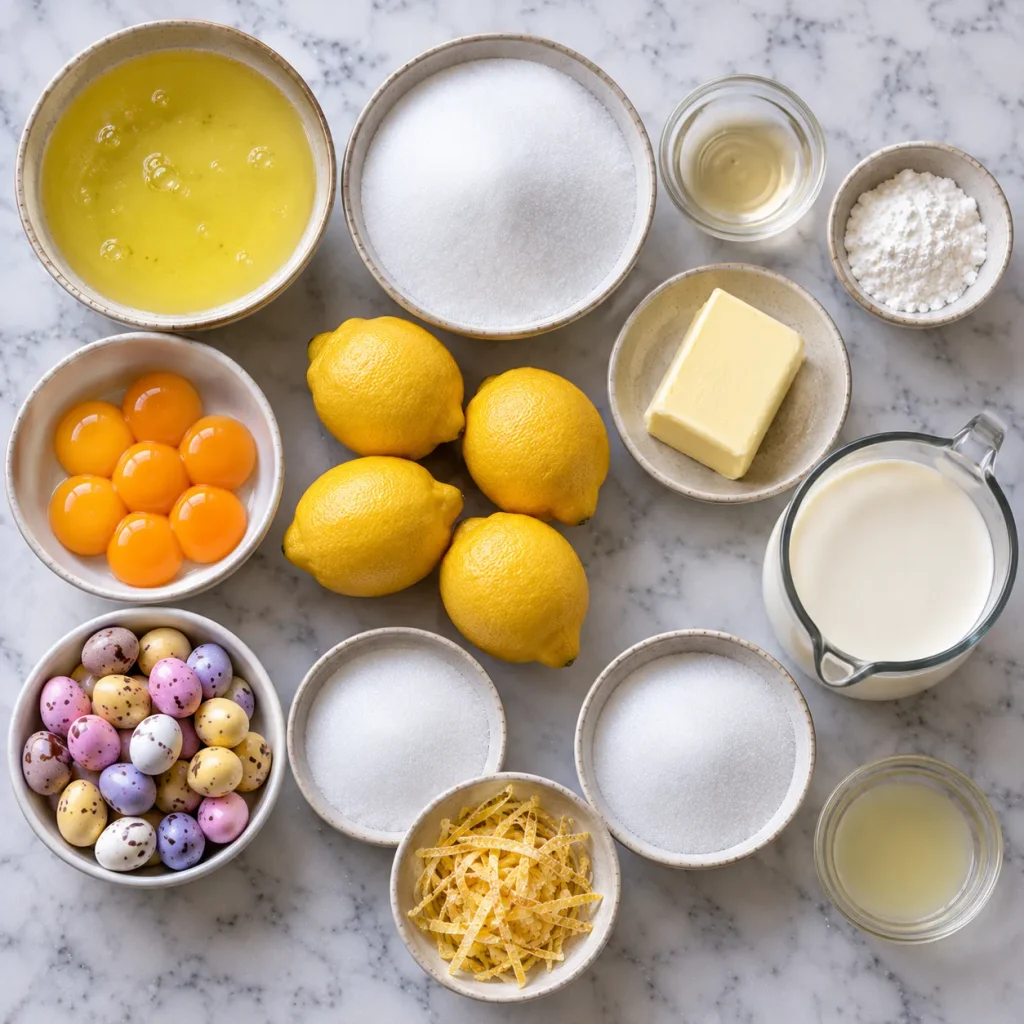
This Mary Berry Easter Lemon Pavlova Recipe uses a simple combination of free-range egg whites, caster sugar, and a little cornflour and vinegar to create a crisp yet soft meringue. The lemon curd is made with egg yolks, fresh lemons, and butter, while double cream, chocolate mini-eggs, and lemon zest complete the festive Easter dessert.
| Ingredient | Quantity |
| Free-range egg whites | 6 |
| Caster sugar | 350g/12oz |
| White wine vinegar | 2 tsp |
| Cornflour | 2 level tsp |
| Free-range egg yolks | 6 |
| Lemons | 4 |
| Butter | 225g/8oz |
| Double cream | 450ml/¾pint |
| Chocolate mini-eggs | 30 |
| Caster sugar | 100g/3½oz |
| Extra caster sugar | For coating |
| Lemon zest | Long thin strips |
| Lemon juice | From the lemons |
How to Make Mary Berry Easter Lemon Pavlova
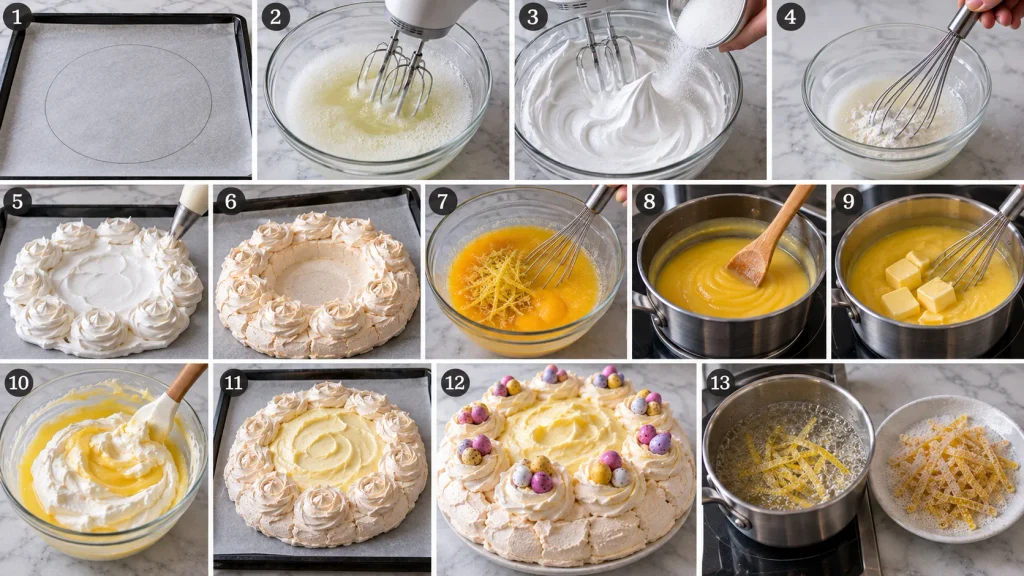
- Preheat the oven to 160C/325F/Gas 3. Line a baking tray with baking paper and draw a 25cm/10in circle on it as a guide.
- Place the egg whites in a spotlessly clean bowl. Using an electric hand-whisk or free-standing mixer, whisk them until stiff peaks form.
- Gradually add the caster sugar, one spoonful at a time, while whisking at maximum speed. Continue until the mixture is stiff and shiny and stands in peaks.
- Blend the white wine vinegar and cornflour together to make a smooth paste. Stir this gently into the meringue mixture until evenly combined.
- Spread half of the meringue over the 25cm/10in circle. Use the remaining mixture in a piping bag to pipe small nests around the edge of the circle.
- Turn the oven down to 150C/300F/Gas 2. Bake the pavlova for 1½ to 2 hours, until it is a pale cream colour and lifts easily from the paper.
- Turn off the oven and leave the pavlova inside to cool completely. Avoid opening the oven door while the meringue is cooling.
- To make the lemon curd, whisk the egg yolks, caster sugar, lemon juice, and lemon zest together. Gently cook the mixture using a double boiler, stirring constantly until thickened.
- Add the butter to the lemon curd and whisk until smooth. Leave the lemon curd to cool completely before assembling the pavlova.
- Whip the double cream until it reaches soft peaks. Gently swirl the cream through the cooled lemon curd to create the lemon cream.
- Spoon the lemon cream into the centre of the pavlova. Arrange the chocolate mini-eggs around the top and place them into the mini nests.
- Prepare the candied lemon zest by boiling the lemon zest briefly in water. Drain it, then coat the long thin strips in caster sugar before using them to decorate the pavlova.
Expert Tips for Mary Berry Easter Lemon Pavlova Recipe
After making meringue desserts, I find that patience and gentle handling make the biggest difference. Keep the bowl completely clean, add the sugar gradually, and allow the pavlova to cool slowly. These simple details help create a stiff and shiny meringue with a crisp outside and soft centre.
- Use a spotlessly clean bowl when whisking the egg whites. Any grease can prevent them from reaching stiff peaks.
- Add the caster sugar gradually rather than all at once. This helps produce a smooth, glossy meringue.
- Whisk at maximum speed until the mixture is stiff and shiny and stands firmly in peaks.
- Mix the vinegar and cornflour into a smooth paste before adding it to the meringue.
- Keep the 25cm/10in circle as your size guide so the pavlova has enough room for the decorative small nests.
- Do not open the oven door during baking or cooling, as sudden temperature changes can affect the meringue.
- Bake until the pavlova is a pale cream colour and lifts easily from the baking paper.
- Let the meringue shell cool completely before adding the lemon curd and cream.
- Cook the lemon curd over gentle heat with constant stirring to help prevent it from catching or becoming lumpy.
- If preparing ahead, keep the unfilled meringue shell separate from the filling and assemble the pavlova closer to serving time.
Serving Suggestions
How to serve Mary Berry Easter Lemon Pavlova:
This Easter dessert is best served shortly after assembling, when the meringue is crisp and the lemon cream is fresh. Spoon plenty of lemon curd cream into the centre of the pavlova, then decorate with chocolate mini-eggs and candied lemon zest for a bright Easter presentation.
- Serve the pavlova chilled or at cool room temperature.
- Garnish with chocolate mini-eggs and candied lemon zest.
- Add fresh fruit such as strawberries for extra colour and freshness.
- Serve smaller slices after a light Easter lunch or dinner.
- Pair with tea, coffee, or a refreshing glass of sparkling water.
- Add fresh berries alongside the lemon cream for a fruity contrast.
- Make it the centrepiece of an Easter dessert table or family gathering.
Storage:
How to store Mary Berry Easter Lemon Pavlova:
Room Temperature
- Keep the cool, unfilled meringue shell in an airtight container for up to 2 days.
- Keep it somewhere cool, dry, and away from moisture.
- Do not leave the finished pavlova with lemon cream at room temperature for long periods.
Refrigerator
- Store the lemon curd and lemon cream in the fridge in covered containers.
- The assembled pavlova is best eaten on the day it is filled.
- Refrigeration can soften the meringue, so keep the filling separate until serving whenever possible.
- Do not reheat the finished pavlova.
Freezer
- The unfilled meringue shell can be frozen for up to 1 month if carefully wrapped and protected from moisture.
- Thaw it at room temperature while still covered, then add the filling once completely thawed.
- Do not freeze the fully assembled pavlova, as the lemon cream can affect the texture of the meringue.
FAQs
Q: Can I make the meringue shell in advance?
Yes. The unfilled meringue shell can be made well in advance and stored in an airtight container for up to 2 days. Add the lemon cream shortly before serving.
Q: Can I use another citrus fruit instead of lemon?
The recipe is designed around lemon, so changing the citrus will alter the flavour. Lime or orange could work, but the lemon curd flavour will be different.
Q: Why did my pavlova become soft?
Moisture is one of the main reasons meringue loses its crisp texture. Store the unfilled meringue shell in a dry place and avoid adding the lemon curd filling until close to serving.
Q: Can I freeze the meringue shell?
Yes, the unfilled meringue shell can be frozen for up to 1 month when well protected from moisture. Thaw it completely before adding the lemon curd filling.
Q: Can I reheat the pavlova?
No. Pavlova should not be reheated after baking or after adding the filling. Reheating can damage the crisp meringue texture.
Q: When should I add the lemon cream?
Add the lemon cream shortly before serving. This helps keep the meringue shell and mini nests as crisp as possible.
Q: What can I use instead of chocolate mini-eggs?
You can leave them out or use other suitable Easter decorations. Fresh fruit and candied lemon zest can also provide attractive toppings.
Q: Can I serve the pavlova with fresh fruit?
Yes. Fresh fruit, especially strawberries and other berries, works well with the lemon curd pavlova and adds a fresh contrast to the sweet meringue.
Nutrition
The following figures are approximate estimates based on the full recipe and an assumed 12 servings. Actual values will vary depending on the exact ingredients, portion size, and amount of lemon cream and chocolate mini-eggs served with each slice.
| Nutrient | Amount Per Serving |
| Calories | 570 kcal |
| Protein | 6 g |
| Carbohydrates | 68 g |
| Sugars | 61 g |
| Fat | 31 g |
| Saturated Fat | 19 g |
| Fibre | 1 g |
| Sodium/Salt | 0.2 g |
1 thought on “Mary Berry Easter Lemon Pavlova Recipe – Lemon Curd & Chocolate Eggs”